Understanding Progressive Education
What is Progressive Education?
Progressive education is an umbrella term for educational philosophies that emphasize child-centered learning, experiential education, and holistic development. Rooted in the ideas of John Dewey and other reformers, this movement challenges traditional, rote-based learning in favor of fostering critical thinking, creativity, and social responsibility.
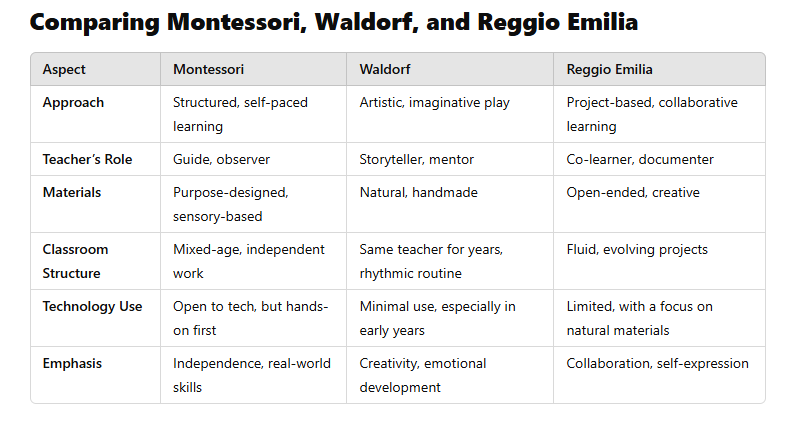
Three of the most well-known progressive education approaches are Montessori, Waldorf, and Reggio Emilia. Each of these methods shares core principles but differs in implementation. Other popular progressive education models include Democratic Schools (Sudbury Schools), Expeditionary Learning, and Forest Schools.
Key Approaches
Montessori Education
Founder: Dr. Maria Montessori (early 1900s)
Core Idea: Children learn best through self-directed, hands-on experiences in a prepared environment.
Classroom Structure: Mixed-age groups with an emphasis on independent exploration.
Role of the Teacher: Observer and guide rather than lecturer.
Materials: Specially designed Montessori materials for sensory-based learning.
Emphasis: Independence, self-discipline, and practical life skills.
Waldorf Education
Founder: Rudolf Steiner (1919)
Core Idea: Education should nurture the whole child—head, heart, and hands—through art, movement, and storytelling.
Classroom Structure: Same teacher follows a class for multiple years.
Role of the Teacher: Storyteller and mentor who guides learning through artistic and experiential methods.
Materials: Natural, handmade materials; limited exposure to technology.
Emphasis: Creativity, rhythm, and imaginative play.
Reggio Emilia Approach
Founder: Loris Malaguzzi (post-WWII)
Core Idea: Children construct knowledge through collaborative, project-based learning.
Classroom Structure: Open-ended, flexible curriculum based on children’s interests.
Role of the Teacher: Co-learner, documenter, and facilitator.
Materials: Natural and recycled materials; art, light, and shadow play.
Emphasis: Community, self-expression, and the "100 languages of children".
Other Progressive Education Approaches
While Montessori, Waldorf, and Reggio Emilia are among the most recognized, other progressive models also offer alternative learning experiences:
1. Expeditionary Learning
Learning through real-world expeditions and fieldwork.
Encourages teamwork, problem-solving, and adventure-based learning.
2. Forest Schools
Nature-based, outdoor learning with an emphasis on environmental stewardship.
Hands-on exploration, risk-taking, and self-directed activities.
3. Democratic Schools (Sudbury Schools)
Children have full autonomy over their learning.
No set curriculum, students learn by choosing their own subjects and activities.
Teachers act as facilitators, not traditional instructors.
Finding the Right Fit
The "best" educational approach is different for every child and family. Some children thrive in one setting but struggle in another. Some families choose to blend different approaches—for example, using Montessori principles at home while attending a Waldorf-inspired preschool or transitioning from Reggio Emilia to Montessori as the child grows.
The key is to observe the child, understand their learning style, and align education with family values. The right approach will foster a lifelong love of learning, confidence, and curiosity.